Town, region and six crus
The area covers Charente and Charente-Maritime plus selected municipalities in Dordogne and Deux-Sèvres. BNIC identifies six crus: Grande Champagne, Petite Champagne, Borderies, Fins Bois, Bons Bois and Bois Ordinaires. These describe origins within the Cognac region. The town marker cannot represent that entire geography, nor does it mean every bottle is produced within the town limits.
Two meanings of Champagne
Grande Champagne and Petite Champagne on a Cognac label refer to local crus. They do not indicate the Champagne wine region in north-eastern France or an addition of sparkling wine. This distinction matters when using a map: a similar name does not place the products in the same region. Cognac remains a spirit distilled from wine rather than a sparkling wine itself.
Colour is not a complete description
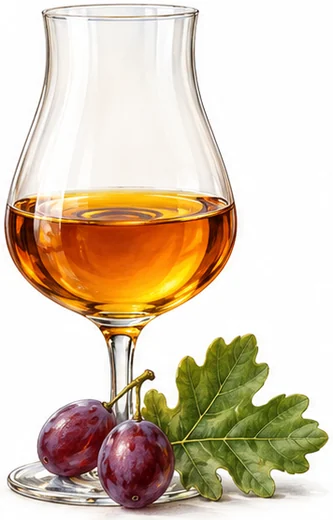
BNIC explains that maturation, origin and wood help influence colour. An amber illustration identifies the family without measuring age. Documented aroma references include flowers, fruit and vanilla. A bottle need not display them all, and an individual producer’s description is more useful than expecting one universal list of flavours across the designation.
Comparing French spirits
Armagnac offers a comparison between two wine-spirit traditions; Calvados also changes the raw material to orchard fruit. Compare complete product names and maturation details rather than assuming all brown spirits are similar. Cognac can be explored neat, but BNIC also describes its place in cocktails and with food. Choose the context before deciding which bottle to compare.
Flavour profile
BNIC describes possible floral, fruit and vanilla notes. Colour and flavour vary between Cognacs; this is a range of documented characteristics, not our own tasting.
How it is served
For a neat serve, BNIC recommends a tulip or stemmed glass. A small pour leaves room to consider the aroma; cocktail use depends on the particular product.
A place on the map
The gazetteer point represents Cognac, not an exact producer address or production boundary. WGS84 source coordinates are retained; decimal places do not imply survey accuracy.
45.69581°N · 0.32867°W
Find on the map →Sources & further reading
- BNIC — Cognac crusSource checked: 2026-10-19
- BNIC — How to taste CognacSource checked: 2026-10-19
- BNIC — ProductionSource checked: 2026-10-19
- BNIC — Patrick Raguenaud, the story of CognacSource checked: 2026-10-19
Original catalogue sources — original check dates retained
- BNIC - The various crus in the Cognac GISource checked: 2026-10-14
- BNIC - How to taste Cognac?Source checked: 2026-10-14
Prepared with AI assistance from the cited sources. No first-hand tastings or invented reviews. About the atlas.