Three parts of a region
Bas-Armagnac, Armagnac-Ténarèze and Haut-Armagnac occupy parts of Gers, Landes and Lot-et-Garonne. Eauze represents Bas-Armagnac, while the surroundings of Condom connect with Ténarèze. The area crosses today’s administrative boundary between Occitanie and Nouvelle-Aquitaine. For a visit, identify a particular estate; one marker cannot show every eligible vineyard.
From grapes to cask
BNIA describes several important varieties, including Ugni Blanc, Baco and Folle Blanche. Most production uses the characteristic continuous Armagnac still. Some producers also use double distillation, so the familiar statement that Armagnac is always distilled once is too absolute. Subsequent oak maturation changes both colour and aroma rather than simply making the same liquid darker.
Young fruit and mature aromas
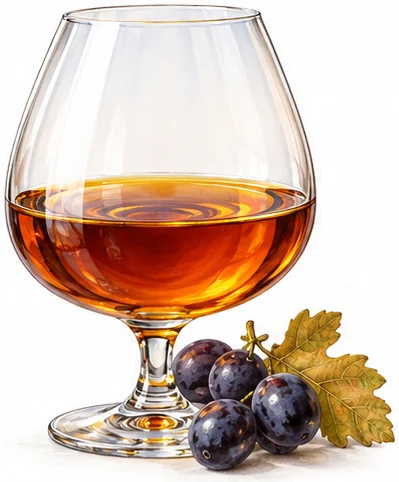
The official style overview associates younger examples with fruit such as pear, plum and grape. Older categories may develop dried-fruit, nut, vanilla and spice notes. Gold can move towards amber and mahogany reflections. These colours are not a reliable age scale, however: the individual product reflects several choices rather than elapsed time alone.
Vintage does not mean years in bottle
Millésime refers to the harvest year. BNIA notes that Armagnac does not continue its wood maturation once bottled. Comparing vintages therefore also requires bottling information. With Cognac, compare origin and production decisions rather than imposing a simple better-or-worse ranking. Both names cover different producers and styles, and neither tells the whole story of a bottle.
Flavour profile
Documented references range from fruit in younger examples to dried fruit, vanilla, nuts and wood with age. No Armagnac is required to express every note.
How it is served
BNIA also suggests younger categories for cocktails and food pairings, and mature examples neat or with selected dishes. Let the individual bottle guide the choice.
A place on the map
The town point represents the stated region or local tradition; it is neither a surveyed production site nor an appellation boundary.
43.86071°N · 0.10061°E
Find on the map →Sources & further reading
- BNIA — Cépages et TerroirSource checked: 2026-10-19
- BNIA — Distillation et vieillissementSource checked: 2026-10-19
- BNIA — Savoir apprécierSource checked: 2026-10-19
Original catalogue sources — original check dates retained
- BNIA - Cépages et TerroirSource checked: 2026-10-14
- BNIA - The last danceSource checked: 2026-10-14
Prepared with AI assistance from the cited sources. No first-hand tastings or invented reviews. About the atlas.