Where the vineyards actually are
The vineyards occupy parts of five départements: Marne, Aube, Aisne, Haute-Marne and Seine-et-Marne. Their outline does not match either former Champagne-Ardenne or present-day Grand Est. Épernay points to an important centre in the Marne Valley. The main subregions also include Montagne de Reims, Côte des Blancs and Côte des Bar, making one marker only a starting point.
What the different wines share
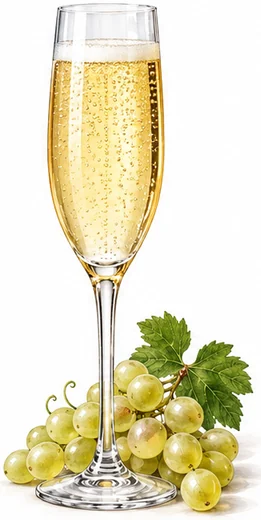
Bubbles develop during fermentation in bottle. That production connection does not entitle every sparkling wine to the Champagne name. Producer choices, grape origins and maturation remain significant differences. The atlas shows a pale example, but the appellation also includes rosé Champagne; rosé is not a separate geographical category.
Sweetness and aroma are different questions
Brut identifies a sweetness style, rather than whether a wine should smell of citrus or bread. Comité Champagne describes a broad aromatic range, from flowers and fruit to brioche and more mature notes. Look for a few distinguishing characteristics in a particular bottle’s description instead of expecting the whole range at once. This also makes ordering easier.
Comparisons and a naming trap
Cava provides a comparison with another appellation using bottle fermentation. Choose a similar sweetness level and a defined style while keeping the different origins in view. Grande Champagne on a Cognac label, meanwhile, identifies a cru in western France. It does not place that spirit among the Champagne vineyards or indicate sparkling wine as an ingredient.
Flavour profile
Documented aromas include flowers, citrus and bread-like notes, depending on style and maturation. None of these is compulsory in every bottle.
How it is served
Comité Champagne recommends 8–10°C and a tall tulip-shaped glass, broader below and narrowing at the top. Select sweetness according to the wine and food.
A place on the map
The gazetteer point represents Épernay, not an exact producer address or production boundary. WGS84 source coordinates are retained; decimal places do not imply survey accuracy.
49.04°N · 3.95922°E
Find on the map →Sources & further reading
- Comité Champagne — The Champagne regionSource checked: 2026-10-19
- Comité Champagne — Frequently asked questionsSource checked: 2026-10-19
- D.O. Cava — Types and varietiesSource checked: 2026-10-19
- Comité Champagne — MaturationSource checked: 2026-10-19
Original catalogue sources — original check dates retained
- Comité Champagne - The Champagne regionSource checked: 2026-10-14
- Comité Champagne - FAQ, serving ChampagneSource checked: 2026-10-14
Prepared with AI assistance from the cited sources. No first-hand tastings or invented reviews. About the atlas.