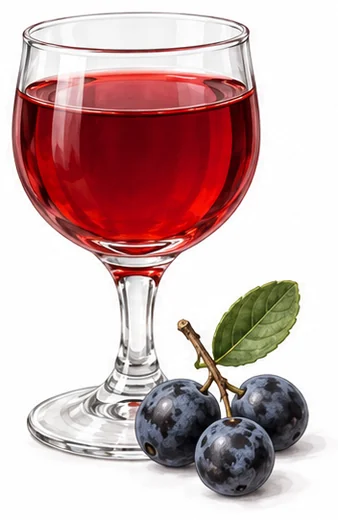
Recognising the fruit
Endrinas are sloes: small, dark blue-black fruits with a bloom. They are not the sour cherries used for ginjinha. The regulatory council describes harvesting after summer and selecting ripe fruit. The finished drink’s red colour belongs to a different stage from the raw fruit’s appearance; the illustration shows that contrast without providing a recipe.
Maceration, rather than fruit distillation
The fruit spends months in a sweetened anise-flavoured alcoholic base, contributing aroma, colour and flavour. This differs from distilling fermented sloes. Sweetness in the base balances the fruit’s astringency. The council identifies INTIA as the external control body, so the regional name also concerns production, rather than merely a general association with Navarre.
What to look for on a bottle
Check the complete name Pacharán Navarro and the producer. The generic word pacharán or a homemade sloe drink is not enough to establish the same controlled identity. When comparing bottles, begin with the category. Red colour alone cannot tell you whether a drink uses sloes, cherries or another fruit, nor whether the regional requirements apply.
Choosing a useful comparison
Ginjinha offers a comparison within sweet fruit liqueurs, but the fruit and the anise base differ. Pastis directs attention to anise without the characteristic sloe maceration; Chartreuse introduces a broader botanical composition. To understand pacharán itself, begin with a simple serve. Juice or another mixer adds a further flavour layer and answers a different tasting question.
Flavour profile
The council describes the sweetened base as balancing sloe astringency. Fruit and anise are the main reference points; their perceived balance varies by bottle.
How it is served
The council suggests drinking it neat and chilled to 3–7°C, or with a little ice. Mixed drinks are separate serving variations.
A place on the map
Estella-Lizarra is a reference point within Navarre. The entry covers the whole protected area, not just this town.
42.67182°N · 2.03226°W
Find on the map →Sources & further reading
- Consejo Regulador — ElaboraciónSource checked: 2026-10-19
- Consejo Regulador — DegustaciónSource checked: 2026-10-19
Original catalogue sources — original check dates retained
- Consejo Regulador — ElaboraciónSource checked: 2026-10-15
Prepared with AI assistance from the cited sources. No first-hand tastings or invented reviews. About the atlas.