A regional name shared by breweries
Kölsch is not a single brand. Different breweries make their own versions within a shared regional identity. The institutional KuLaDig resource describes its pale colour, clarity and hop-led character, and connects it with Cologne and the surrounding area. The atlas uses the city as the centre of that tradition. It does not outline the full geographical scope of the protected name, which also includes specified places and historically entitled producers outside Cologne’s city boundary.
Why it is not simply a pils
Both beers can look clear and pale gold, but Kölsch is top-fermented, while Pilsner belongs to the lager family. This distinction is more helpful than trying to identify the style by colour alone. A hop accent and a light presentation are useful expectations, though bitterness should not be assumed identical across breweries. KuLaDig also distinguishes Kölsch from local Wieß, a top-fermented beer that remains naturally cloudy. Similar origins or similar-looking glasses do not make the beers interchangeable.
Stange, Köbes and the beermat
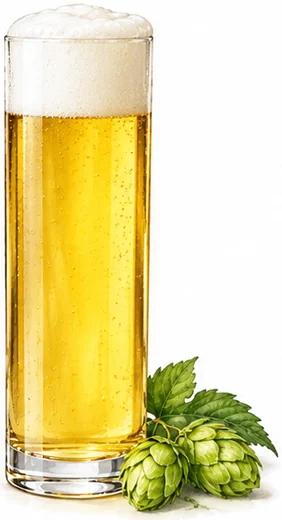
The typical Stange is a straight-sided cylindrical 0.2-litre glass. A server known as a Köbes may bring a fresh glass without a separate order. Cologne’s tourist board explains that putting your beermat over the glass signals that you have finished. This is practical guidance for a traditional brewery pub, not a rule for every modern venue. Check the brewery name on the tap or menu when choosing. Comparing two named local versions is more informative than treating all Kölsch as one product with a single fixed taste.
Flavour profile
Pale and clear, with a hop accent. Individual bitterness and aroma depend on the brewery; a regional name is not one brand’s tasting note.
How it is served
The classic serve is freshly poured beer in a 0.2-litre Stange. In traditional brewery pubs, a beermat over the glass signals that you do not want another.
A place on the map
The gazetteer point represents Köln, not an exact producer address or production boundary. WGS84 source coordinates are retained; decimal places do not imply survey accuracy.
50.93333°N · 6.95°E
Find on the map →Sources & further reading
- LVR / KuLaDig — Brauhaus- und Kölschkultur in KölnSource checked: 2026-10-19
- KölnTourismus — Brauhäuser in KölnSource checked: 2026-10-19
Original catalogue sources — original check dates retained
- Kölner Brauerei-Verband - Kölsch verbindetSource checked: 2026-10-14
- EUR-Lex - Kölsch, publikacja specyfikacjiSource checked: 2026-10-14
- KuLaDig - Brauhaus- und Kölschkultur in KölnSource checked: 2026-10-14
Prepared with AI assistance from the cited sources. No first-hand tastings or invented reviews. About the atlas.